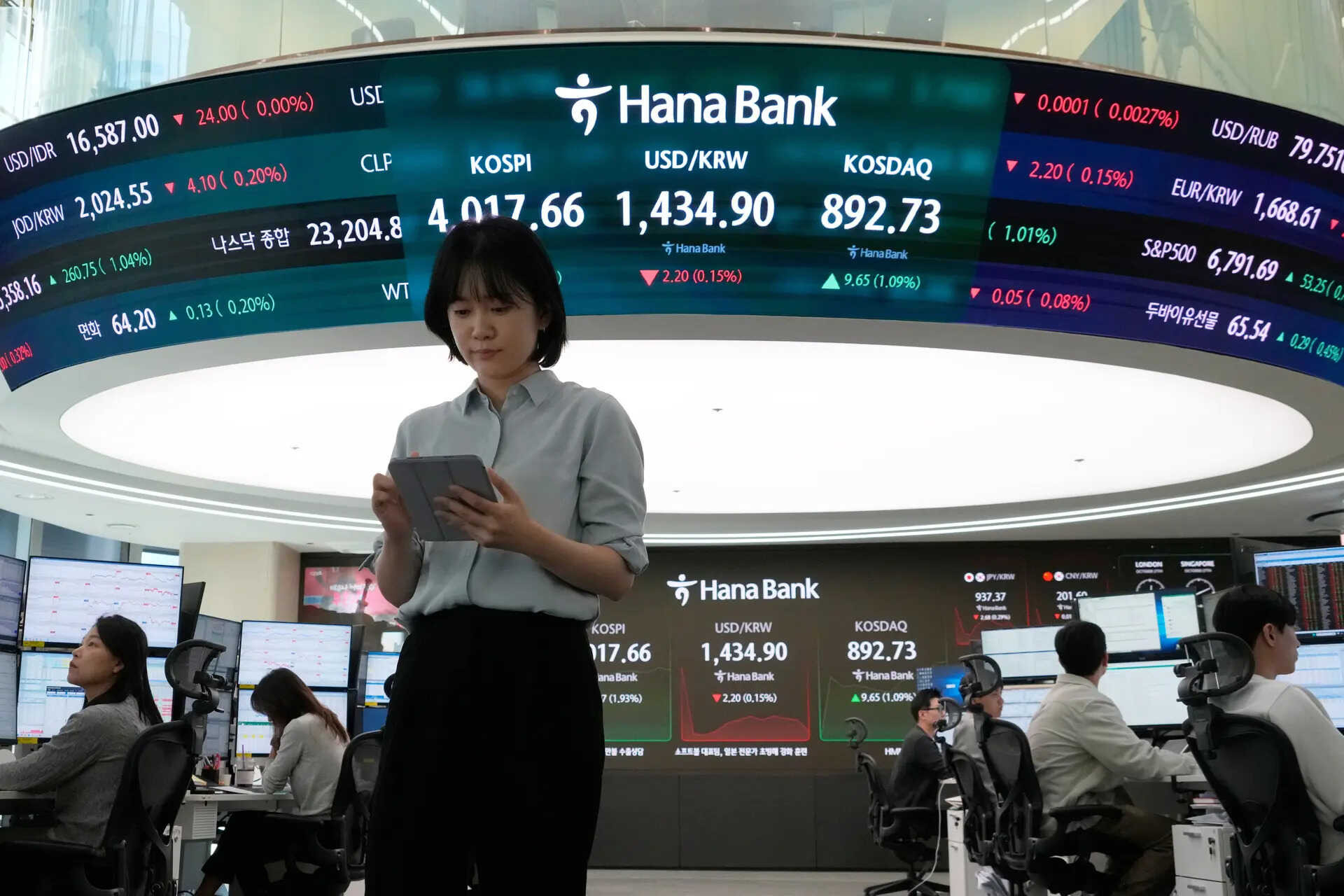
Asian markets saw mixed trading, mirroring Wall Street’s gains but tempered by anticipation of key US economic data and the Federal Reserve’s upcoming meeting. Investors await crucial inflation and jobs figures, with a December rate cut widely expected. Strong US Black Friday sales offered some market cheer, while Bitcoin rebounded after a recent dip.
Navigating the Murky Waters: Asian Markets Grapple with US Economic Signals
Asian markets presented a mixed bag today, a reflection of the global uncertainty hanging heavy in the air as traders brace for crucial economic data releases from the United States. The picture painted wasn’t one of decisive momentum, but rather a cautious tiptoe as investors try to predict the ripples these figures will send across the financial landscape. Forget clear skies and smooth sailing – we’re in for some choppy waters.
Hong Kong’s Hang Seng index bore the brunt of the unease, flirting with a near 1% loss, while Japan’s Nikkei 225 offered a brighter spot, surging with an addition of over 800 points. This divergence underscores the complex interplay of factors at play, from local economic conditions to the ever-present influence of the world’s largest economy.
Why the jitters? All eyes are glued to the imminent release of key US economic indicators. These data points, encompassing everything from inflation rates to employment figures, act as vital clues, hinting at the Federal Reserve’s next move regarding interest rates. Will they stay the course, continue their hawkish stance, or perhaps, just perhaps, signal a potential slowdown in tightening? The answer to that question will dramatically reshape market sentiment.
The Hang Seng’s Hesitation and Nikkei’s Ascent
The Hang Seng’s struggle likely stems from a combination of factors, including concerns surrounding the Chinese economy and ongoing geopolitical tensions. The index, heavily weighted towards Chinese companies, is particularly sensitive to any negative news emanating from the mainland. Lingering worries about the property sector and the potential for slower growth are undoubtedly weighing on investor confidence.
In stark contrast, the Nikkei’s impressive gains suggest a more optimistic outlook for Japan. A weaker yen, which boosts the competitiveness of Japanese exports, coupled with signs of increasing domestic demand, are likely fueling the rally. Furthermore, some analysts believe that Japanese companies are becoming more shareholder-friendly, with increasing dividends and share buybacks adding to the allure for investors.


Decoding the US Economic Data Puzzle
The influence of US economic data on Asian stock markets cannot be overstated. A stronger-than-expected US economy, while seemingly positive on the surface, could embolden the Federal Reserve to maintain its aggressive interest rate policy. This, in turn, would likely strengthen the dollar, putting pressure on Asian currencies and potentially leading to capital outflows from the region.
Conversely, weaker-than-expected data could signal a slowdown in the US economy, prompting the Fed to pause or even reverse its rate hikes. This scenario would likely weaken the dollar, provide relief to Asian currencies, and boost investor sentiment towards emerging markets. It’s a high-stakes game of prediction, and everyone’s waiting for the dealer to reveal the cards.
Other Asian markets are similarly treading carefully. South Korean and Australian markets are showing modest gains, reflecting a cautious optimism tempered by the uncertainty surrounding the US data. Regional currencies are also experiencing volatility, fluctuating in response to the latest whispers and rumors circulating in the trading rooms.
Beyond the Numbers: Geopolitics and Global Uncertainty
While economic data is undeniably crucial, it’s important to remember that other factors are also at play. Geopolitical tensions, particularly those involving China and the United States, continue to cast a long shadow over the markets. Any escalation of these tensions could trigger a flight to safety, sending investors scurrying towards less risky assets like US Treasury bonds and gold.
The ongoing war in Ukraine and its impact on global energy prices also add another layer of complexity. Higher energy costs can fuel inflation, putting further pressure on central banks to raise interest rates, which in turn can dampen economic growth.

Check out our analysis on the impact of global supply chains on emerging markets for more on related topics.
Navigating these turbulent waters requires a steady hand and a keen understanding of the interconnectedness of the global economy. Investors must carefully weigh the potential impact of US economic data, geopolitical risks, and other macroeconomic factors to make informed decisions. One thing is certain: volatility is here to stay.
The Road Ahead
Ultimately, the direction of Asian stock markets hinges on the signals emanating from the US economy. Whether the data confirms expectations, surprises to the upside, or disappoints, the fallout will be felt across the globe. While the immediate reaction may be driven by short-term sentiment, the long-term impact will depend on how central banks respond and how businesses adapt to the evolving economic landscape. Preparing for any scenario is key. The interplay between economics and international relations will continue to influence the global stage.