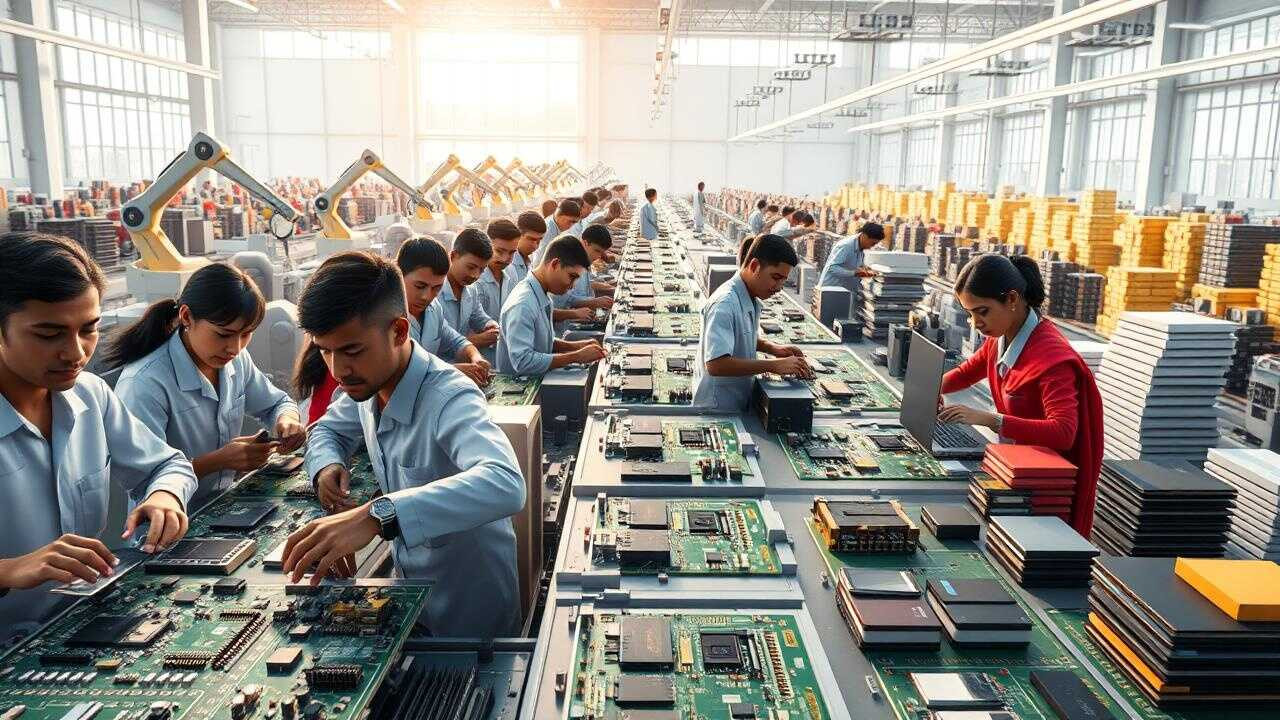
India’s electronics sector is experiencing significant growth, driven by new free trade agreements and supportive government policies. Industry leaders anticipate a surge in exports to $120 billion by March 2026, with ambitious long-term targets. Reforms, skilling initiatives, and new manufacturing projects are strengthening domestic capabilities and integrating India into global value chains.
India’s Electronics Manufacturing Ascends: Can We Reach the $500 Billion Summit?
For years, whispers of India becoming a global electronics manufacturing powerhouse have echoed through industry halls. Now, those whispers are growing into a roar. The ambition? A staggering $500 billion electronics manufacturing industry by 2030. It’s a bold target, but a confluence of factors suggests it’s not just wishful thinking.
Several tailwinds are propelling this surge. Think of it as a perfectly orchestrated symphony, with each instrument playing its crucial part.
FTAs: Opening Doors to Global Electronics Markets
Free Trade Agreements (FTAs) are playing a pivotal role. These agreements are like removing trade barriers, allowing smoother and cheaper access to crucial markets. With reduced tariffs and simplified customs procedures, Indian electronics manufacturers can compete more effectively on the global stage. This isn’t just about selling more; it’s about integrating into global supply chains in a meaningful way. FTAs provide predictable frameworks, fostering investment and encouraging technology transfer, essential ingredients for sustained growth.
Government Incentives: Fueling the Electronics Manufacturing Engine
Beyond FTAs, proactive government initiatives are supercharging the sector. Production-Linked Incentive (PLI) schemes, for example, are designed to reward companies for increasing their domestic production. This incentivizes both local and international players to invest in Indian manufacturing. These aren’t just handouts; they’re strategic investments that build capacity, encourage innovation, and create jobs. Coupled with schemes promoting electronics manufacturing clusters, the government is creating a fertile ground for the industry to flourish.

The impact is already visible. We’re seeing a rise in domestic manufacturing of smartphones, components, and other electronic goods. This reduces reliance on imports, strengthens the economy, and enhances India’s strategic autonomy. It’s a win-win scenario.
Shifting Global Supply Chains: India’s Opportunity
The geopolitical landscape is also shifting to India’s advantage. Businesses worldwide are actively diversifying their supply chains to mitigate risks associated with over-reliance on any single country. India, with its large skilled workforce, democratic values, and growing economy, is emerging as an attractive alternative. This isn’t just a short-term trend; it’s a fundamental realignment of global manufacturing.
Companies are looking for stability and predictability, and India, with its improving infrastructure and business environment, offers a compelling proposition. This presents a golden opportunity for the country to become a key node in the global electronics ecosystem.
Overcoming Challenges: The Road Ahead
Reaching the $500 billion target won’t be a walk in the park. Several challenges need to be addressed head-on. Infrastructure bottlenecks, including inadequate logistics and power supply, remain a concern. Skill gaps in the workforce need to be bridged through targeted training programs. Further, fostering a culture of innovation and R&D is crucial for moving up the value chain and competing with global leaders.
Attracting foreign investment is also essential, but it requires continuous improvement in the ease of doing business. Streamlining regulations, reducing bureaucratic hurdles, and ensuring policy stability are critical to building investor confidence.


Is the $500 Billion Goal Attainable?
So, can India truly reach the $500 billion milestone by 2030? The ingredients are undoubtedly there: supportive government policies, favorable global trends, and a growing domestic market. However, success hinges on effectively addressing the challenges and sustaining the momentum.
By focusing on infrastructure development, skill enhancement, innovation, and ease of doing business, India can unlock its full potential and become a global electronics manufacturing hub. If you’re curious about other economic sectors experiencing rapid growth, check out our article on the booming renewable energy sector in India.
The journey might be complex, but the destination—a thriving, self-reliant electronics industry—is well worth striving for. It represents not just economic growth, but also technological advancement, job creation, and enhanced national competitiveness.